FUE or FUT for Crown Hair Loss – Which Is Best?
A thinning crown can feel especially frustrating because it is difficult to monitor on your own. You may notice more scalp showing in overhead lighting, a widening swirl in photos, or a family member pointing out a spot you did not realize had progressed. When comparing FUE or FUT for crown restoration, the right choice is less about a universally “better” procedure and more about how each technique fits your hair loss pattern, donor supply, goals, and lifestyle.
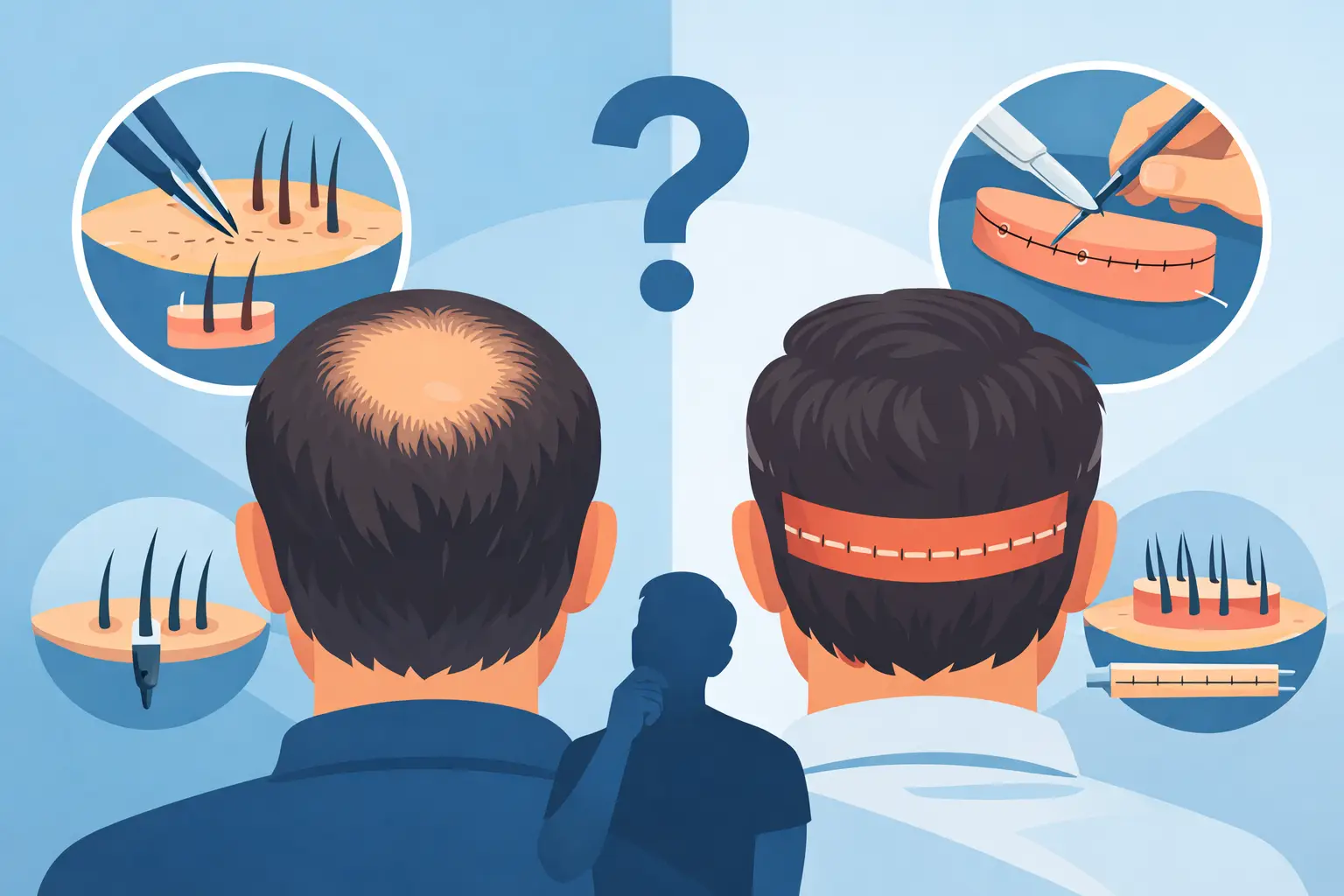
Both procedures transplant healthy, permanent-resistant follicular units from the donor area – typically the back and sides of the scalp – into thinning areas. The transplanted hairs can grow naturally for years. The difference is how those grafts are harvested, how much coverage is needed, and what type of scar pattern is most appropriate for you.
Why Crown Restoration Requires Careful Planning
The crown is not a flat area of the scalp. Hair grows in a circular pattern around a central whorl, and that pattern differs from person to person. Recreating it requires thoughtful graft placement, proper angle control, and realistic density planning. A crown that is filled too aggressively without respecting the natural swirl can look artificial, particularly under bright light or when hair is worn short.
Crown thinning also tends to be progressive. If the surrounding native hair continues to thin after a transplant, a once-blended result can begin to look less balanced. That is why a physician should evaluate not only the visible spot today, but also your family history, the stability of your hair loss, donor density, hair caliber, and the likelihood of future loss.
For some patients, medication, regenerative hair loss injections, or low-level laser therapy may help preserve existing hair before or alongside a transplant. A complete plan protects the investment in your results.
FUE for Crown Hair Loss
Follicular Unit Extraction, or FUE, removes individual follicular units one at a time from the donor area. These grafts are then placed into tiny recipient sites designed to follow the crown’s natural direction and swirl.
FUE is often appealing to patients who prefer short hairstyles or want to avoid a linear donor scar. Instead of one line, FUE leaves small, dispersed dot-like scars that are generally difficult to notice once the surrounding hair grows in. It is not a scar-free procedure, but the scar pattern can be a meaningful advantage for the right candidate.
When FUE May Be a Strong Choice
FUE may be well suited for a patient with good donor density, a modest to moderate crown area, and a preference for wearing the sides and back relatively short. It can also be an excellent option for patients who may need grafts placed in more than one area, such as a receding hairline plus early crown thinning, because the treatment plan can distribute grafts strategically.
With advanced options such as ARTAS robotic FUE, eligible patients may benefit from technology that helps identify and harvest suitable follicular units with precision. Technology is a tool, not a replacement for medical judgment. The design, recipient-site creation, density strategy, and long-term plan still require experienced physician oversight.
The main trade-off with FUE is graft supply. Every patient has a limited donor reserve, and extensive harvesting can thin the donor area if not planned conservatively. For a large crown, especially in someone with advanced pattern baldness, preserving donor resources is essential.
FUT for Crown Hair Loss
Follicular Unit Transplantation, or FUT, is sometimes called the strip method. A narrow strip of donor-bearing scalp is removed from the back of the head, and the follicular units are carefully separated for transplantation. The donor area is then closed, leaving a linear scar.
FUT can provide a high number of quality grafts in a single session and may be particularly valuable when a patient needs substantial crown coverage. It can also preserve more of the surrounding donor area from diffuse extraction, which may matter for patients with extensive hair loss or a strong possibility of needing additional restoration later.
When FUT May Be a Strong Choice
FUT may make sense when the crown is significantly thin or bald and the patient needs a larger graft count to create meaningful coverage. It can also be a practical choice for someone who usually wears their hair longer in the back, where a well-healed linear scar is typically concealed.
The primary consideration is the scar. While skilled closure techniques are designed to minimize its appearance, a linear scar can become visible with very short haircuts or a shaved head. Recovery may also involve more tightness or discomfort in the donor area during the early healing period compared with FUE.
FUT is not an outdated option. For the right patient, it remains an effective surgical technique that can produce natural, high-impact crown restoration. The best approach is the one that uses your donor hair responsibly while supporting your long-term appearance.
FUE or FUT for Crown Coverage: The Key Differences
The comparison often comes down to coverage needs, donor management, and hairstyle preference. FUE harvests grafts individually and creates a dispersed scar pattern. FUT can yield a larger number of grafts efficiently but leaves a linear scar.
Neither procedure can create unlimited density. The crown can require a significant number of grafts because it covers a broad surface area, yet the donor area has finite resources. If you also have frontal hairline recession, your physician may recommend prioritizing the hairline and frontal third first. Those areas frame the face and are more visible in everyday conversation. A crown transplant can still be performed, but the graft budget needs to be managed wisely.
Hair characteristics influence the decision as well. Coarser or wavier hair can create the appearance of greater coverage than fine, straight hair. A person with excellent donor density and favorable hair caliber may achieve a stronger cosmetic result with fewer grafts than someone with fine hair and a larger bald area.
What Results Can You Expect?
A crown transplant does not produce instant cosmetic density. Transplanted hairs usually shed within the first several weeks, which is a normal part of the process. New growth often begins around three to four months, with visible improvement building gradually. Most patients see a more meaningful change between six and nine months, while crown results can continue to mature for 12 months or longer.
The goal is natural-looking coverage that blends with existing hair and follows your individual growth pattern. Results can look full and refined, but responsible expectations matter. If the crown is completely bald and large, creating the density of untouched teenage hair may not be realistic. A skilled plan focuses on the greatest visual improvement while protecting the donor supply for the future.
Questions to Ask During Your Consultation
A productive consultation should go beyond asking whether FUE or FUT is less invasive. Ask how many grafts may be needed for the crown, whether your donor area can safely support that number, and how future hair loss could affect the result. You should also discuss whether nonsurgical treatment may help stabilize thinning hair around the transplant area.
At Austin Hair Clinic, patients receive a personalized scalp analysis and treatment discussion centered on their specific pattern of loss. Dr. Sanjeev Dubey and the clinical team consider surgical and nonsurgical options with the same goal: helping you achieve a natural-looking result that supports confidence over time.
Frequently Asked Questions
Is FUE better than FUT for a crown transplant?
Not automatically. FUE may be preferable if you want to wear shorter hair or have a moderate area to treat. FUT may be more efficient for a larger crown requiring a higher graft count. Your donor quality and long-term hair loss pattern should guide the decision.
Will transplanted crown hair look natural?
It can, provided the grafts are placed to match the direction, angle, and swirl of your native crown. Artistic placement is especially important in this area because the growth pattern is highly visible.
Can I treat the crown and hairline in one procedure?
Sometimes, yes. However, the available graft supply must be divided carefully. Many patients benefit from prioritizing the hairline and frontal area, then addressing the crown in a later session if needed.
The best next step is not choosing a procedure from a comparison chart. It is having your scalp, donor hair, and future risk of loss assessed by an experienced medical hair restoration team, then choosing the plan that lets your results look natural now and remain believable years from now.