Robotic Transplant or Manual FUE Compared
A hair transplant is not simply a matter of removing follicles and placing them somewhere else. The way grafts are selected, protected, and placed affects density, hairline softness, and how natural your results look years from now. If you are weighing a robotic transplant or manual FUE, the better choice is rarely about which option sounds more advanced. It is about which approach best fits your hair characteristics, restoration goals, and donor supply.
Both methods use Follicular Unit Extraction, or FUE, a minimally invasive technique that removes individual follicular units from the donor area, usually at the back and sides of the scalp. Neither option leaves the linear scar associated with traditional strip surgery. The real distinction is how grafts are harvested and how much flexibility the surgical team has while responding to your unique scalp and hair pattern.
How Robotic and Manual FUE Differ
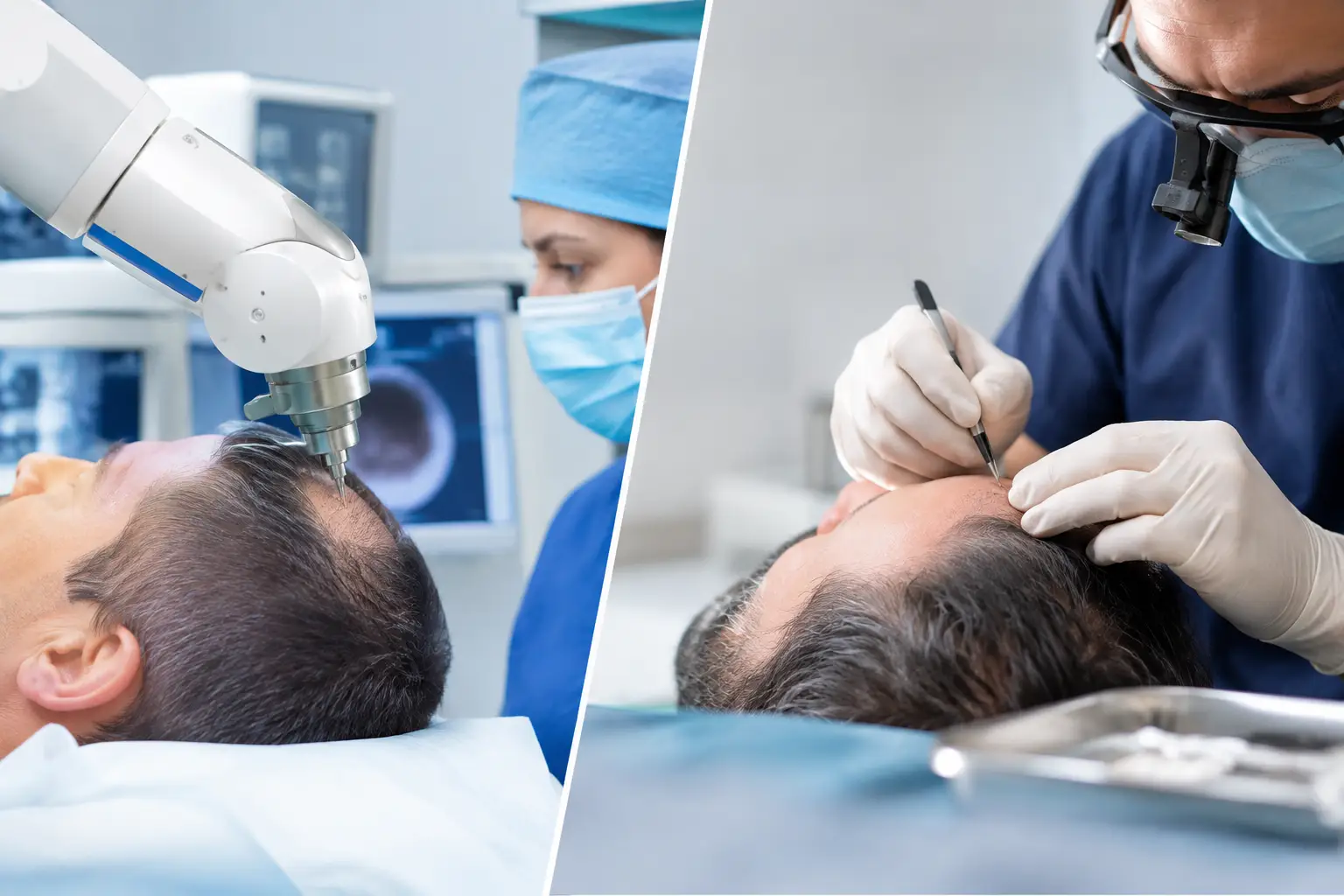
FUE is a technique, not a single device. In manual FUE, an experienced physician or surgical team uses specialized handheld instruments to score and remove individual follicular units. With robotic FUE, a computer-guided system such as ARTAS® uses advanced imaging and robotic precision to help identify and harvest suitable grafts.
Both approaches can produce excellent, natural-looking outcomes in the right hands. The difference is in the workflow. Robotic technology can assist with consistency and speed during graft selection and extraction. Manual FUE gives the physician greater real-time control over the angle, depth, and selection of every graft, particularly when donor hair varies significantly across the scalp.
The most meaningful question is not, “Is robotic better?” It is, “Which method gives my surgical plan the best chance of preserving donor hair and meeting my aesthetic goals?”
Robotic Transplant or Manual FUE: What Each Does Well
Robotic FUE and technology-assisted precision
Robotic FUE uses imaging to map the donor area, identify follicular groupings, and assist with harvesting according to the treatment plan. For appropriate candidates, this technology can make extraction highly consistent and may reduce the fatigue-related variability that can occur during longer procedures.
ARTAS® robotic FUE can be especially appealing to patients who value a technology-forward process and want a carefully planned procedure with computerized donor-area analysis. The system may efficiently harvest a large number of grafts while distributing extractions throughout the donor zone to help maintain a natural appearance.
Still, the robot is a surgical tool, not a replacement for medical judgment. A physician must determine whether a patient is a suitable candidate, design the hairline, plan graft distribution, supervise the procedure, and make decisions that protect the long-term appearance of the donor area. Technology can support precision, but artistic judgment remains essential.
Manual FUE and surgeon-directed adaptability
Manual FUE relies on the experience and dexterity of the physician and surgical team. The operator can adjust technique from one area of the scalp to another, responding to changes in hair angle, curl pattern, follicle depth, scalp firmness, and graft quality.
That adaptability can be particularly valuable for patients with challenging donor characteristics, very curly or tightly curled hair, prior transplant scarring, or a need for highly selective graft harvesting. Manual FUE may also be preferred when a plan calls for detailed work in smaller areas, such as refining a hairline, restoring eyebrows, or creating beard density.
Manual does not mean less precise. In a skilled medical practice, it can be exceptionally meticulous. The trade-off is that results are more directly dependent on the training, consistency, and artistic eye of the person performing the extraction and placement.
Your Hair Characteristics Matter More Than the Marketing
A transplant method should be selected after a close scalp and donor evaluation, not after watching a device demonstration or comparing procedure names online. Your hair type, degree of hair loss, donor density, scalp laxity, and future hair-loss risk all shape the right plan.
For example, someone with stable pattern hair loss, favorable donor density, and hair characteristics that work well with robotic imaging may be an excellent candidate for ARTAS® robotic FUE. Another patient may have mixed hair directions, significant curl, or limited donor supply that calls for a more customized manual approach.
Women considering hair restoration also need individualized evaluation. Diffuse thinning can affect the donor area, and some forms of shedding or medical hair loss should be treated before surgical restoration is considered. A transplant is most successful when the underlying diagnosis is clear and the donor hair is strong enough to support the plan.
Age matters, but not in the way many patients assume. A younger patient with rapidly progressing hair loss may need a conservative hairline and a long-term strategy that includes medication, regenerative hair loss injections, or low-level laser therapy. Building an aggressive hairline without accounting for future loss can create an unnatural appearance later, regardless of whether the grafts were harvested manually or robotically.
Natural Results Depend on More Than Graft Extraction
Patients often focus on extraction because it is where the word “robotic” gets attention. But the visual success of a transplant is heavily influenced by planning and placement.
A natural hairline requires irregularity that looks intentional, not random. It needs appropriately fine grafts in the leading edge, a thoughtful transition into denser areas, and a design that suits your facial proportions and likely future hair loss. Crown restoration requires a different approach because the hair grows in a circular pattern and can require substantial graft numbers to create visible coverage.
Graft handling also matters. Follicles are living tissue. They must be removed carefully, kept properly hydrated and protected, and placed at angles that match the surrounding native hair. A transplant that uses impressive technology but ignores hair direction, density transitions, and donor preservation can still look artificial.
This is why physician oversight is not a minor detail. The best procedure is one guided by a medically sound diagnosis, a realistic graft budget, and an aesthetic plan that respects both your current appearance and your future hair-loss pattern.
Recovery, Scarring, and Timeline Expectations
Both robotic and manual FUE are minimally invasive and create small extraction sites rather than a long linear incision. Tiny scabs in the donor and recipient areas are normal during early healing. Most patients can return to light, non-strenuous activity relatively quickly, although they should follow their physician’s instructions on exercise, washing, sun exposure, hats, and medications.
The transplanted hairs commonly shed within the first several weeks. This can feel discouraging, but it is a normal part of the growth cycle. New growth often begins around three to four months, becomes more noticeable over subsequent months, and continues maturing for up to 12 to 18 months. Hair texture and density can improve gradually throughout that period.
No FUE method makes scarring impossible. However, properly spaced extractions, careful punch selection, and responsible donor management help make the small scars difficult to detect once the hair is grown out. Overharvesting is a concern with any extraction method, which is why donor preservation should always take priority over pursuing an unrealistic graft count.
Cost Should Reflect the Plan, Not Just the Device
Robotic FUE and manual FUE pricing can differ based on the technology used, the number of grafts needed, the complexity of the case, and the level of physician involvement. A lower per-graft price may not represent the best value if the treatment plan is poorly designed or fails to account for progressive hair loss.
During a consultation, ask what is included in the quoted cost, who performs each stage of the procedure, how graft numbers are determined, and what strategy is recommended to protect existing hair. You should also ask whether non-surgical treatments could help stabilize thinning before or after surgery.
For many patients, the strongest plan combines a transplant with medical hair-loss management. Transplanted follicles are typically selected from areas that are more resistant to genetic thinning, but the native hair around them can continue to miniaturize. Treating that ongoing loss helps preserve a fuller, more balanced result.
Choosing the Approach With Confidence
There is no universal winner between robotic and manual FUE. Robotic technology can offer impressive consistency and efficient donor-area harvesting for well-matched candidates. Manual FUE can provide greater flexibility for complex hair characteristics and highly customized work. Both can be part of an excellent restoration plan when performed with sound medical judgment and aesthetic precision.
At Austin Hair Clinic, a consultation begins with a close evaluation of your scalp, donor area, hair-loss pattern, and goals – not a one-size-fits-all recommendation. The right next step is a personalized assessment that helps you protect what you have, understand what is possible, and move forward with a plan built for natural-looking confidence.