
Hair Transplant vs PRP Therapy: Which Fits?
If you are weighing hair transplant vs PRP therapy, you are probably not looking for a textbook answer. You want to know what will actually make a visible difference in the mirror, what will feel worth the investment, and what makes sense for your stage of hair loss.
That is the right way to approach it, because these treatments are not interchangeable. A hair transplant and PRP therapy can both play a role in hair restoration, but they solve different problems. One is designed to permanently redistribute healthy follicles into thinning or bald areas. The other is meant to support and stimulate existing follicles that are still alive but underperforming.
Hair transplant vs PRP therapy: the core difference
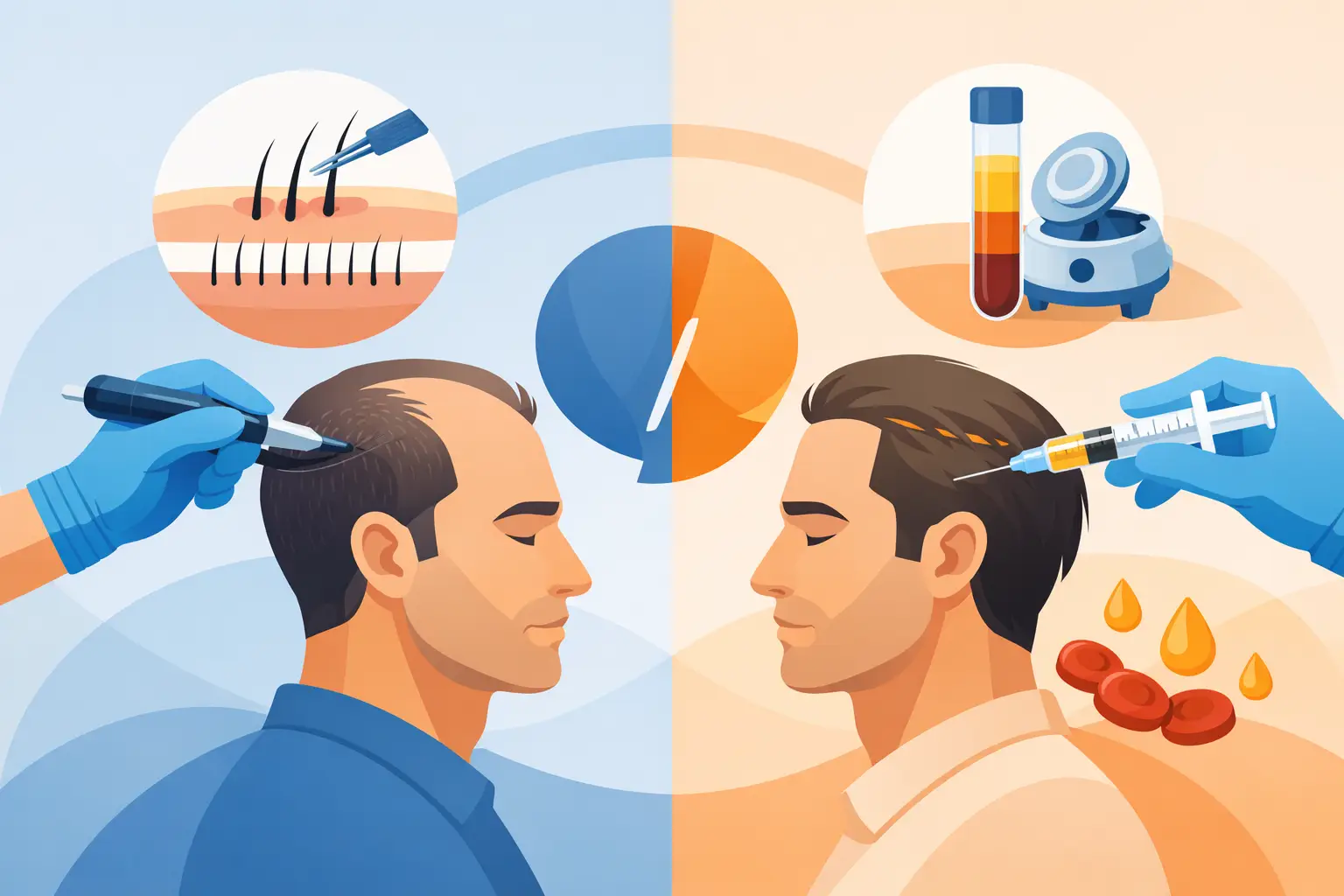
A hair transplant is a procedure that moves hair follicles from a donor area, usually the back or sides of the scalp, into areas where hair is thinning or gone. In modern FUE procedures, follicles are harvested individually and placed with careful attention to angle, density, and hairline design. The goal is natural-looking, lasting growth in areas that no longer have enough viable hair.
PRP, or platelet-rich plasma therapy, is a non-surgical treatment. A small sample of your blood is processed to concentrate the platelets, and that plasma is then injected into the scalp. Those growth factors may help improve the environment around weakened follicles, which can support thicker, healthier growth in some patients.
That difference matters. A transplant adds hair to an area that needs more coverage. PRP works best when there is already hair present to strengthen. If an area is completely slick bald, PRP is unlikely to create meaningful new coverage on its own.
When a hair transplant is usually the better option
If your hairline has significantly receded, your crown has a clear bald spot, or you have areas where density is no longer enough to conceal the scalp, a transplant is often the more effective solution. This is especially true for pattern baldness, where follicles in certain zones have miniaturized beyond recovery.
The biggest advantage of transplantation is that it can produce visible structural change. It can rebuild a hairline, fill in temples, restore density to the crown, or improve beard and eyebrow fullness in the right candidate. For patients who want a dramatic correction rather than subtle improvement, this is often the treatment that aligns with their goals.
A transplant also tends to be the better fit when hair loss has become stable. If you are continuing to lose native hair quickly, your physician may recommend controlling that progression first or combining surgery with supportive therapies. The best cosmetic outcome usually comes from planning not just for today, but for how your hair may change over the next several years.
That said, a transplant is still a medical procedure. It requires donor hair, careful candidacy screening, recovery time, and realistic expectations about growth. The new hair does not appear overnight. Transplanted follicles typically shed first, then begin growing over the following months, with fuller results taking shape over time.
When PRP therapy makes more sense
PRP is usually better suited for patients in earlier stages of hair thinning. If your part is widening, your ponytail feels smaller, your crown looks thinner under overhead light, or your hairline is starting to soften but not fully disappear, PRP may help preserve and improve what is still there.
For many men and women, the appeal is obvious. It is minimally invasive, there is little downtime, and it can fit into a broader treatment plan without surgery. Patients who are not ready for a transplant, are not yet candidates, or want to be proactive about thinning often start here.
The trade-off is that PRP generally offers improvement, not replacement. Results can vary depending on age, genetics, degree of miniaturization, and overall scalp health. Some patients notice thicker caliber, less shedding, and better density. Others see more modest change. It is best viewed as a supportive treatment, not a guaranteed answer for advanced loss.
Which treatment gives more noticeable results?
If the question is which one creates the bigger visual change, the answer is usually a hair transplant. That is because transplantation physically relocates follicles into areas that need coverage. When performed well, it can reshape the frame of the face and restore density in a way that is difficult to match with non-surgical options alone.
PRP can absolutely be valuable, but its strength is enhancement. It may improve the quality of existing hair, help prolong the life of compromised follicles, and support overall scalp vitality. For someone with mild to moderate thinning, that can be enough to make styling easier and improve confidence. For someone with a bare frontal hairline, it usually will not deliver the level of change they are hoping for.
This is where expectations matter. Patients are happiest when the treatment matches the problem. PRP for early thinning can be a smart move. PRP for long-standing baldness often leads to frustration. A transplant for someone seeking lasting hairline restoration is often the more direct path.
Cost, downtime, and long-term value
PRP usually has a lower upfront cost than a hair transplant, which is one reason many patients consider it first. But PRP is often performed as a series of treatments followed by maintenance sessions. Over time, those recurring visits can add up.
A transplant requires a larger initial investment, yet it offers permanent follicle relocation in the treated areas. That can make it a better long-term value for patients with established loss who want meaningful, durable change. Cost should not be the only factor, but it is worth thinking beyond the first appointment and looking at the bigger timeline.
Downtime is also different. PRP usually allows you to return to normal activities quickly. A transplant has a recovery process, including short-term redness, scabbing, and a waiting period for growth. Most patients accept that trade-off because they are choosing the procedure for a more substantial result.
Hair transplant vs PRP therapy: do you ever need both?
Often, yes. This is where personalized planning becomes more important than picking a winner.
A transplant can restore hair in areas that need coverage, while PRP may help support native hair around those transplanted grafts. In some cases, PRP is used as part of a broader strategy that also includes medication, laser therapy, or nutritional support. The goal is not just to fill in empty space, but to protect the hair you still have.
This combination approach can be especially helpful for patients with pattern hair loss that is still progressing. You may need one treatment to rebuild and another to maintain. That is not over-treatment. It is often the most realistic way to create a result that looks natural now and continues to look balanced later.
At Austin Hair Clinic, this kind of planning is a major part of the consultation process. The right recommendation depends on your donor supply, the pattern of loss, your age, your goals, and how aggressive your thinning appears to be.
How to tell which category you fall into
If you still have a fair amount of hair in the area that concerns you, but the strands are getting finer and the scalp is becoming more visible, PRP may be worth discussing. If the area is mostly bald, your hairline has clearly moved back, or you are trying to rebuild shape and density that no longer exist, a transplant is more likely to be the right fit.
There are exceptions. Some patients with diffuse thinning need a more nuanced plan. Some women are strong candidates for non-surgical therapy before surgery is even considered. Some men benefit from restoring the hairline surgically while treating crown thinning conservatively. Hair restoration is rarely one-size-fits-all.
A proper evaluation should include scalp analysis, a close look at donor quality, family history, and a realistic conversation about what result would actually satisfy you. The best treatment plan is not the newest one or the least invasive one. It is the one that solves the problem you actually have.
The real question is not which is better
Patients often ask whether PRP is better than a transplant because they want the simplest answer. The better question is what your hair needs right now.
If you need to restore lost coverage, a hair transplant is usually the stronger option. If you need to strengthen thinning hair before it gets worse, PRP may be a smart first step. And if you want the best chance at both restoration and preservation, a combination plan may make the most sense.
What matters most is choosing a treatment based on diagnosis, not hope. Hair loss can feel personal and urgent, but good decisions come from clear medical guidance and an honest look at your goals. The right plan should not just promise improvement. It should give you a realistic path back to feeling like yourself again.