Hair Transplant Options Explained for Natural Results
A receding hairline can change how you feel when you look in the mirror long before it changes how others see you. For people weighing hair transplant options explained in clear, practical terms, the best choice is rarely about finding one “best” procedure. It is about matching your pattern of hair loss, donor-hair quality, goals, lifestyle, and timeline to a medically sound plan.
A natural-looking result depends on far more than moving hairs from one place to another. It requires thoughtful hairline design, careful graft placement, realistic density planning, and an honest discussion about how future hair loss may affect the result. The right treatment can restore more than coverage. It can help you feel more like yourself again.
Hair Transplant Options Explained: The Main Choices
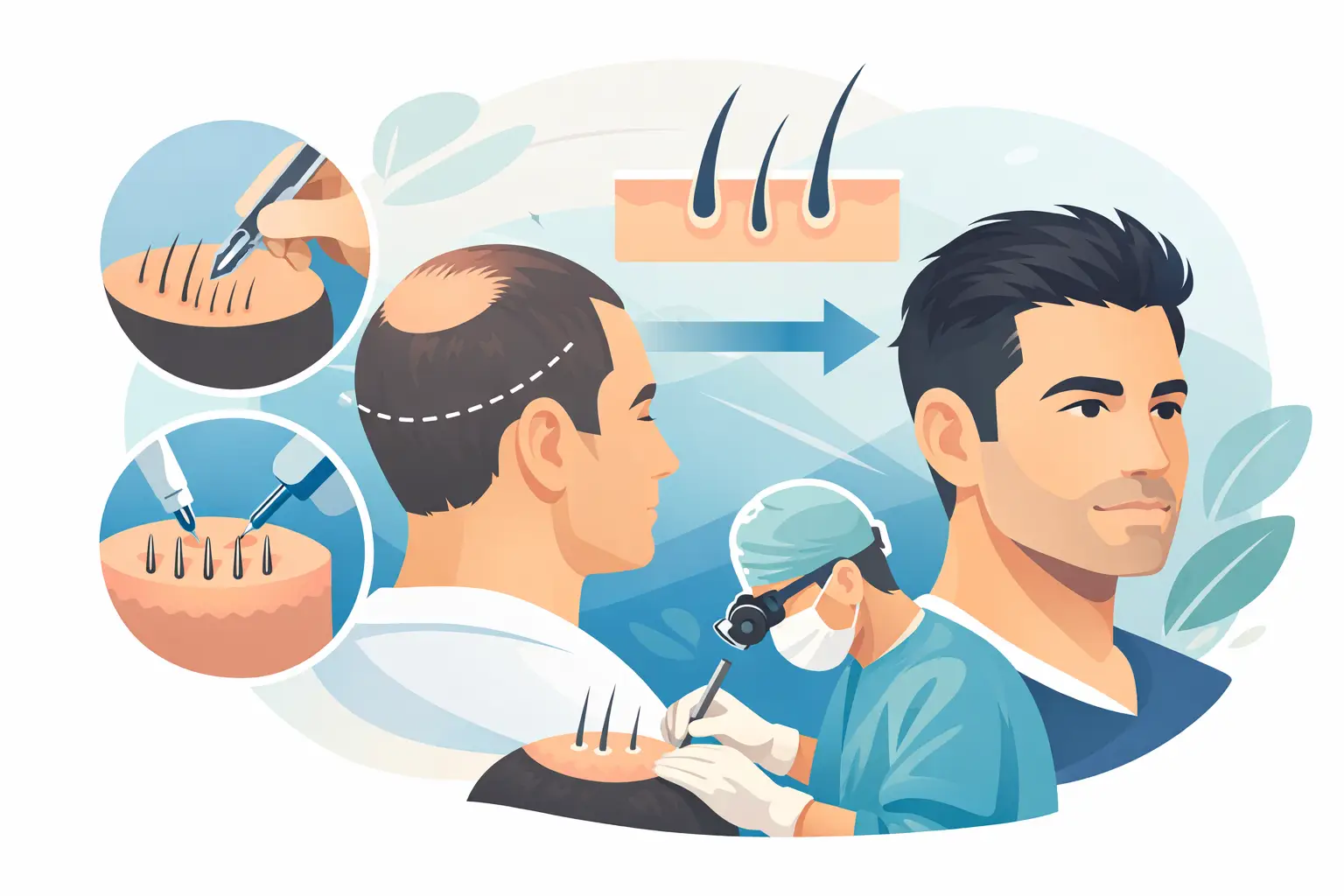
Hair transplantation uses healthy, genetically resistant follicles from the donor area, usually the back and sides of the scalp, to restore thinning or bald areas. The transplanted follicles continue to grow hair in their new location after the healing and growth cycle is complete.
The two established ways to harvest donor follicles are Follicular Unit Extraction, known as FUE, and Follicular Unit Transplantation, known as FUT or strip surgery. Robotic systems such as ARTAS are a technology-assisted approach to FUE, not a separate transplant method. Facial hair transplantation also uses FUE principles but requires its own level of artistic precision.
FUE: A Minimally Invasive, Flexible Option
FUE involves removing individual follicular units from the donor area with a small punch instrument. Those grafts are then prepared and placed into tiny recipient sites in the thinning area, hairline, crown, beard, or eyebrows.
For many patients, FUE is appealing because it does not leave a linear strip scar. Instead, it leaves small dot-like scars that are generally difficult to see once the surrounding hair grows out. Recovery is usually straightforward, and many people return to desk work and light social activities within several days, although strenuous exercise should wait until the care team says it is safe.
FUE can be an excellent choice for men who prefer shorter hairstyles, women who want to preserve flexibility in how they wear their hair, and patients seeking a natural restoration of the hairline or crown. It may also be appropriate for a staged approach, where grafts are used conservatively now while preserving donor supply for the future.
The trade-off is that FUE can require trimming part of the donor area, and the number of grafts that can be safely harvested depends on donor density and scalp characteristics. A quality FUE procedure is also highly detail-dependent. The angle, direction, and distribution of every graft influence whether the finished result looks soft and believable.
ARTAS Robotic FUE: Technology With Physician Planning
ARTAS robotic FUE uses imaging and robotic-assisted harvesting to identify and remove suitable follicular units from the donor area. The technology can support consistency and efficiency during harvesting, particularly for appropriate candidates with sufficient donor-hair characteristics.
However, a robot does not replace medical judgment or aesthetic design. The most visible part of a transplant is the recipient area: the hairline, the density pattern, the direction of growth, and the way new hairs blend with existing hair. Those decisions require experienced physician oversight and a personalized surgical plan.
ARTAS may be a strong fit for patients interested in advanced technology and a minimally invasive FUE approach. It is not automatically the right answer for every hair type, hair-loss pattern, or restoration goal. A consultation should determine whether robotic harvesting, manual FUE, or another strategy offers the most predictable path.
FUT: When Strip Harvesting May Be Considered
FUT removes a narrow strip of donor-bearing scalp, which is then dissected into individual follicular grafts. The donor area is closed with a linear scar that is typically concealed by surrounding hair.
For some patients, FUT can provide a larger number of grafts in one session and may be worth discussing when significant coverage is needed. It can also preserve the option of using FUE in a future procedure, depending on the individual donor supply and surgical plan.
The main consideration is the linear scar and the recovery associated with the donor incision. Patients who wear their hair very short often prefer FUE for that reason. FUT is not outdated, but it is not ideal for everyone. The best method is the one that protects your donor area while supporting a natural result you can maintain over time.
Facial Hair Transplants Need a Different Design Approach
Scalp hair restoration and facial hair restoration share the same basic principle, but the aesthetic goals are different. Beard and eyebrow transplantation require close attention to hair caliber, curl pattern, angle, and placement.
For beard restoration, grafts can fill patchy areas, improve cheek or jawline definition, camouflage scars, or create fuller facial-hair density. Eyebrow restoration is even more precise. Each graft must be placed at a very shallow angle so the brow lies naturally against the skin rather than growing outward.
Because transplanted scalp follicles may continue to grow at scalp-hair length, eyebrow patients should expect occasional trimming and grooming. The reward is a permanent, natural-looking enhancement when the procedure is planned with restraint and artistry.
Non-Surgical Treatments Can Protect Your Results
A transplant redistributes existing donor hair. It does not stop genetic hair loss in the surrounding, non-transplanted hair. That is why many patients benefit from a combined plan that addresses both restoration and ongoing hair preservation.
Medication may help slow progressive thinning or support existing hair, depending on your medical history and the cause of loss. Low-level laser therapy and regenerative hair loss injections may also be considered as complementary options for appropriate candidates. Nutritional support can be useful when deficiencies or hair-health concerns are part of the picture, but supplements are not a substitute for diagnosing the reason behind hair loss.
For patients who are not ready for surgery, non-surgical care may be the right starting point. For others, it can strengthen the long-term appearance of a transplant by helping preserve the native hair around it. The treatment plan should be based on evidence, safety, and realistic expectations rather than a one-size-fits-all promise.
Who Is a Good Candidate for a Hair Transplant?
The strongest candidates usually have stable or reasonably predictable hair loss, healthy donor density, and goals that match the available supply of grafts. Age matters, but it is not the deciding factor by itself. A younger patient with rapidly progressing hair loss may need a conservative hairline and a medical plan before surgery. A patient in their 50s or 60s may be an excellent candidate if donor hair and overall health are favorable.
A thorough assessment should examine the scalp, donor region, family history, medication use, and pattern of thinning. Diagnostic testing may be helpful when shedding is diffuse, sudden, or inconsistent with typical pattern hair loss. Conditions such as inflammatory scalp disease, untreated hormonal concerns, or certain forms of alopecia may require medical treatment before transplant surgery is considered.
Equally important is expectation-setting. A transplant can create meaningful improvement, but it cannot recreate the density of a teenage hairline across a large bald area without limits. An experienced provider will explain how many grafts are reasonable, where they will have the greatest visual impact, and whether more than one session may be appropriate.
What the Timeline Really Looks Like
Transplanted hairs typically shed within the first few weeks after surgery. This is expected and does not mean the grafts have failed. New growth commonly begins around three to four months, becomes more noticeable between six and nine months, and continues maturing for up to 12 to 18 months.
Patience matters because hair grows slowly, and the final result develops gradually. In the meantime, following post-procedure instructions helps protect the grafts during the critical early healing period. Avoiding picking, friction, early intense exercise, and unapproved hair products can make a real difference.
Questions Worth Asking at Your Consultation
A consultation should leave you more informed, not pressured. Ask who will design the hairline, perform each key part of the procedure, and oversee your care. Ask how the provider estimates graft needs, how donor hair will be protected, and what plan is recommended if your hair loss continues.
You should also ask to see results from patients with a similar hair type, degree of loss, and restoration goal. Before-and-after photos can be helpful, but the most meaningful results show natural hairline irregularity, appropriate density, and a believable blend with existing hair.
At Austin Hair Clinic, the goal of a scalp analysis and consultation is to give you that clarity. Whether FUE, ARTAS robotic FUE, facial hair restoration, or non-surgical treatment makes sense, the right plan should feel medically responsible and personally achievable. A thoughtful first conversation can turn uncertainty about hair loss into a clear next step toward feeling confident in your appearance again.