Beard Hair Transplant Cost: What to Expect
A patchy beard can change the way you feel about your profile, jawline, and overall appearance – especially when grooming tricks stop making a difference. For many men, beard hair transplant cost becomes the first big question after they realize a fuller beard is actually possible.
The short answer is that cost varies widely based on how much density you want, how many grafts are needed, and who performs the procedure. A small area of beard enhancement may cost far less than a full beard reconstruction. What matters most is not finding the lowest number, but understanding what you are paying for and whether the result will look natural on your face for years to come.
What affects beard hair transplant cost?
Beard transplantation is usually priced according to graft count, procedural complexity, and the level of physician oversight involved. If you are filling in a few thin spots on the cheeks, the investment will usually be lower than it would be for creating a new goatee, connecting the mustache, or rebuilding a beard after scarring.
Graft count is the biggest cost driver. Every follicular unit has to be harvested, prepared, and placed with attention to angle, direction, and density. Facial hair is less forgiving than scalp hair because people view it up close. If the hairs are placed at the wrong angle, the beard can look unnatural even if the grafts survive well.
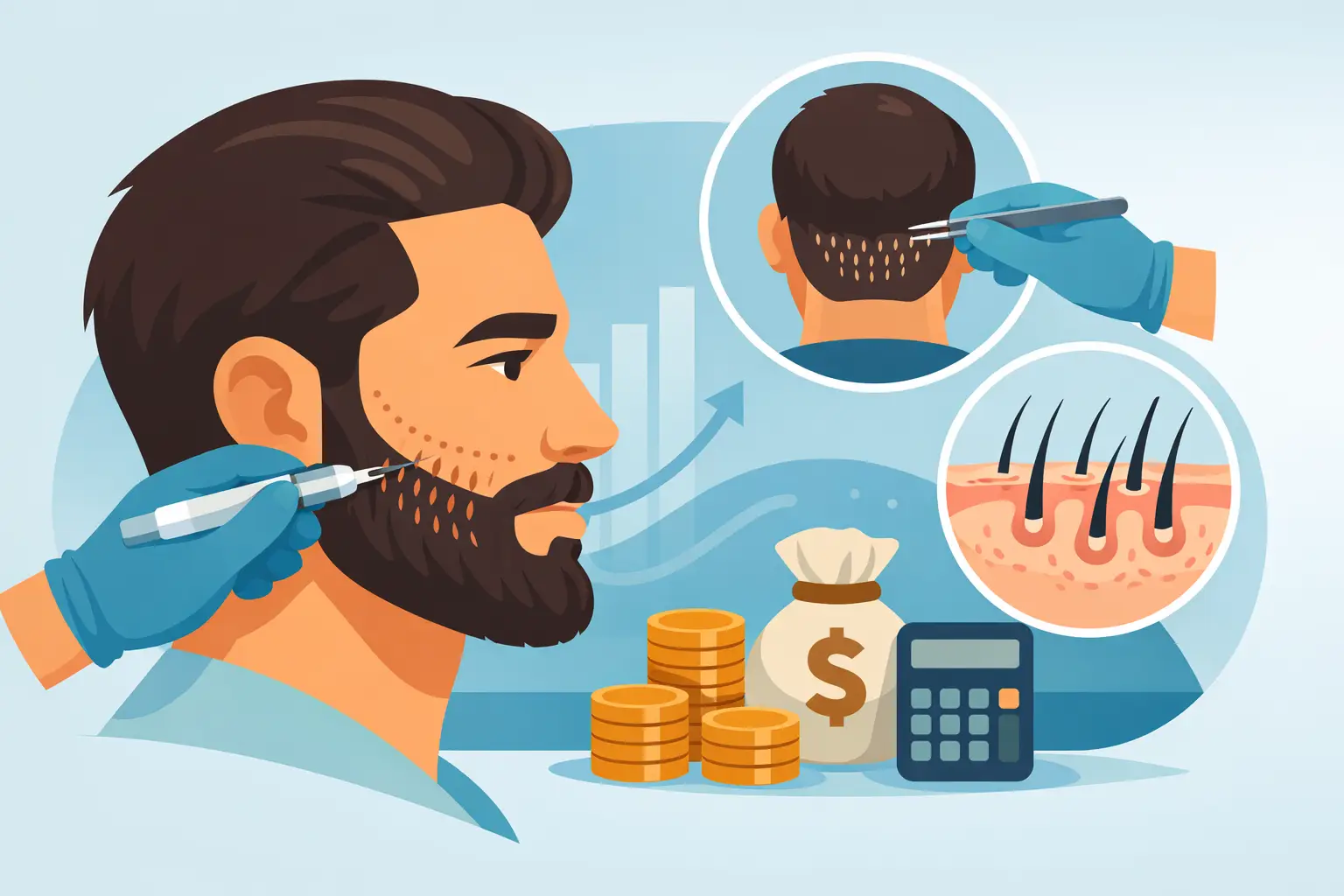
Technique also matters. Most modern beard restoration procedures use FUE, which removes individual follicles from the donor area, typically the back of the scalp. FUE avoids a linear scar and can offer a more comfortable recovery for many patients, but it is still a detailed, labor-intensive procedure. The more refined the placement plan and the more customized the design, the more likely price will reflect that level of work.
Provider experience can also change the range. A board-certified physician with extensive aesthetic hair restoration experience may charge more than a low-cost clinic built around volume. That difference is not just about reputation. Beard work requires artistic judgment as much as technical skill, and that judgment directly affects how believable the result looks in daily life.
Typical beard hair transplant cost ranges
In the United States, beard hair transplant cost often falls somewhere between a few thousand dollars and well over $10,000, depending on the scope of treatment. Smaller touch-up cases may sit on the lower end of the range, while full beard creation or major density work can move significantly higher.
A patient wanting subtle cheek filling may need a few hundred grafts. Someone seeking fuller coverage across the cheeks, jawline, and mustache area may need 1,500 to 2,500 grafts or more. Since pricing often tracks the number of grafts and the complexity of placement, those two patients should not expect the same quote.
This is why broad online price estimates can be frustrating. They are useful for setting expectations, but they rarely reflect your exact anatomy, beard pattern, donor supply, and aesthetic goals. A proper consultation is what turns a rough estimate into a realistic treatment plan.
Why per-graft pricing is only part of the story
Some clinics quote a flat price, while others use a per-graft model. Per-graft pricing can sound straightforward, but beard work is not always comparable to scalp work on a simple cost-per-follicle basis. Facial hair placement is detail-heavy, and design precision matters a great deal.
A lower per-graft price does not always mean lower overall value. If the result lacks natural direction, symmetry, or age-appropriate density, correcting it may cost more later. Patients are often better served by asking what is included in the procedure rather than focusing only on the headline number.
What is usually included in the price?
When comparing quotes, ask whether the fee covers the entire treatment process or just the procedure itself. Some clinics bundle consultation, planning, harvesting, graft placement, post-op instructions, and follow-up visits into one price. Others separate parts of the process.
It is also worth asking about medication, aftercare supplies, and whether touch-up work is discussed up front if growth falls short of expectations. Transparency matters. A reputable practice should be comfortable explaining what the quoted cost includes, what could change it, and what kind of result is realistically achievable.
For many patients, financing is part of the conversation too. Since beard transplantation is considered an elective cosmetic procedure, insurance usually does not cover it. Monthly payment options can make treatment more manageable, but the decision should still be based on quality and fit, not payment structure alone.
Why beard design matters as much as price
A beard transplant is not just about moving hair from one area to another. It is facial design. The density of the cheeks, the shape of the goatee, the transition into the sideburns, and the softness or sharpness of the outline all affect whether the result suits your features.
This is where cheap pricing can become expensive. If a clinic overbuilds density in one zone, uses the wrong angulation, or creates a beard line that looks too harsh, the result can draw attention for the wrong reasons. Natural-looking work often comes from restraint, planning, and customization.
For professionals and appearance-conscious patients, this trade-off matters. Most men do not want a beard that looks transplanted. They want a beard that looks like it has always belonged there.
Is a beard transplant worth the cost?
That depends on what is bothering you and what outcome you want. If your beard is mildly uneven and easy to style around, surgery may not feel necessary. If patchiness affects your confidence, limits how you present yourself, or has been resistant to every grooming product you have tried, the value calculation changes.
For many patients, the appeal is permanence. Unlike fibers, pencils, or strategic trimming, a successful beard transplant grows from your own follicles. Once healed and matured, it can be shaved, shaped, and maintained like natural facial hair.
Still, worth is personal. The best candidates tend to be those with realistic expectations, stable goals, and enough healthy donor hair to support the plan. A good consultation should tell you not only whether you can do the procedure, but whether you should.
How to compare clinics without getting lost in the numbers
Price shopping is normal, but beard restoration should not be treated like a commodity. Two clinics can quote the same graft count and deliver very different outcomes. When evaluating options, it helps to look at facial hair before-and-after photos, ask who designs the hairline and beard pattern, and understand how involved the physician is on procedure day.
You should also pay attention to how the clinic talks to you. Do they explain limitations clearly? Do they discuss donor management and facial symmetry? Do they give you a personalized recommendation, or do they push the biggest procedure possible? Those details often tell you more than a promotional price ever will.
At a specialized hair restoration practice like Austin Hair Clinic, patients are typically guided through both the medical and cosmetic side of the decision. That matters because the best plan is not always the most aggressive one. It is the one that fits your face, donor supply, and long-term goals.
Questions to ask at your consultation about beard hair transplant cost
A strong consultation should leave you with more clarity, not more confusion. Ask how many grafts are estimated, what areas will be treated, what technique will be used, and whether the quote includes follow-up care. It is also smart to ask when results are expected to appear and whether any complementary therapies are recommended.
If you have scarring, poor previous work, or a limited donor area, bring that up early. Those factors can affect both complexity and cost. They can also change whether one session is enough or whether a staged plan makes more sense.
The most helpful consultation is one that balances honesty with possibility. You want a team that can show you what is achievable without overselling a transformation your donor area cannot support.
The real value behind the investment
When patients ask about beard hair transplant cost, they are usually asking two questions at once: What will this procedure cost me, and what will it give me back? A fuller beard can sharpen facial structure, improve balance, and restore confidence in a way that feels surprisingly personal.
The right place to start is not with the cheapest quote. It is with a careful evaluation of your goals, your donor hair, and the experience of the team doing the work. When the design is thoughtful and the procedure is done well, the investment is about more than facial hair – it is about seeing yourself the way you want to be seen.
If you are considering treatment, the smartest next step is a consultation where your plan is built around your face, not a generic price range.