Minoxidil vs Laser: Which Helps Hair Loss?
A widening part, more scalp visible under office lighting, or a hairline that seems to move back in every photo can make the choice feel urgent. In the minoxidil vs laser conversation, both options can support hair growth, but they work differently, require different levels of commitment, and may fit different stages of hair loss.
For many men and women with early thinning, the question is not whether one treatment is universally better. It is whether the treatment matches the cause of their hair loss, their lifestyle, and the result they hope to see. A personalized assessment can make that decision far clearer than choosing based on advertising alone.
Minoxidil vs Laser: The Core Difference
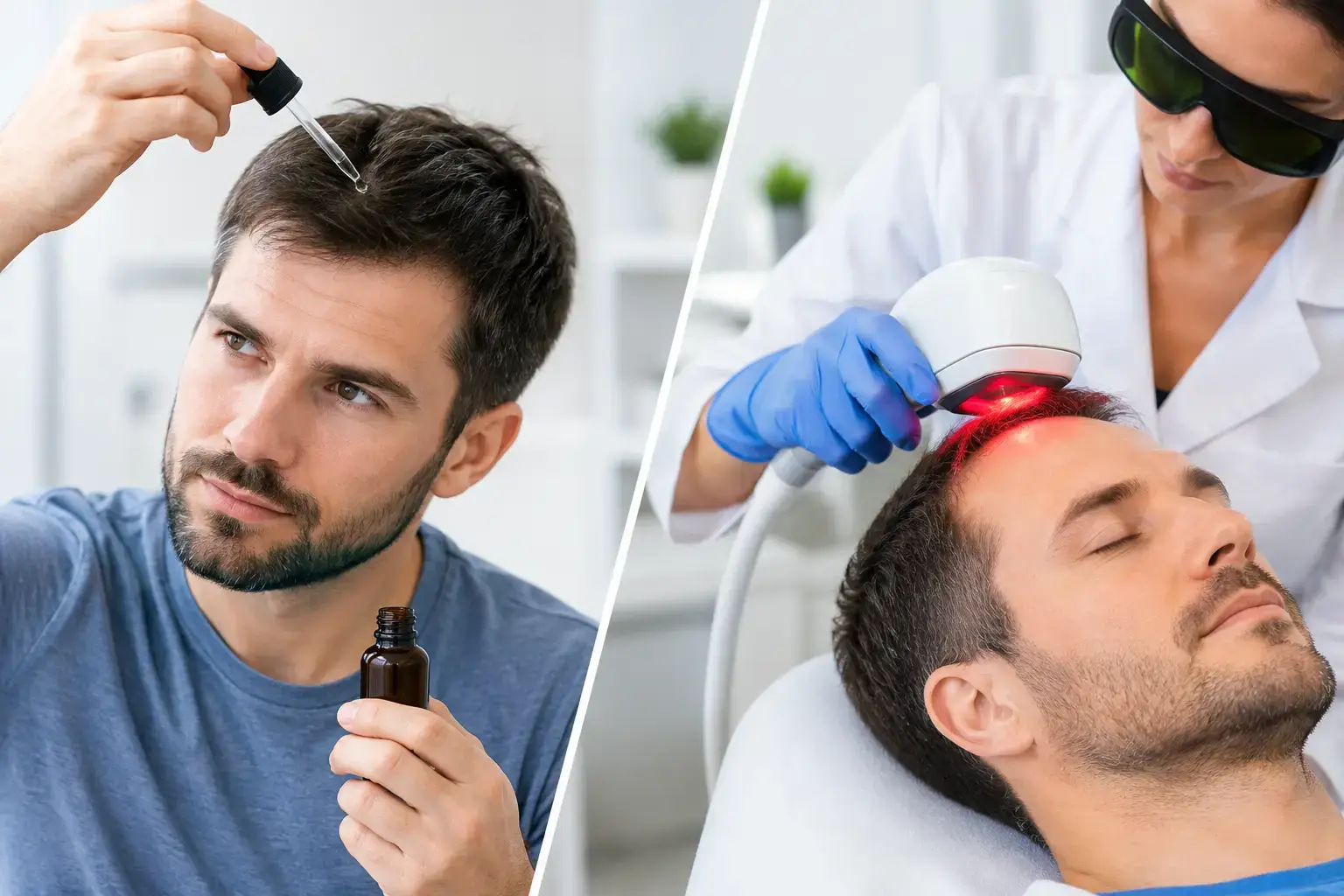
Minoxidil is a medication applied to the scalp, most often as a liquid or foam. It is available over the counter in topical forms and is commonly used for androgenetic alopecia, also called male or female pattern hair loss. While its exact mechanism is not fully understood, minoxidil is believed to help extend the growth phase of the hair cycle and improve conditions around the follicle that support growth.
Low-level laser therapy, often called LLLT or red-light therapy, uses specific wavelengths of light delivered through a cap, helmet, comb, or in-office device. The goal is photobiomodulation: encouraging cellular activity in follicles that are still present but producing finer, shorter hairs. Laser therapy does not create new follicles in areas where follicles have been lost permanently.
Both treatments are designed to preserve and strengthen vulnerable native hair. Neither is a quick fix for a completely bare scalp, and neither replaces a hair transplant when the goal is to restore density in an established bald area.
How Minoxidil Fits Into a Hair Loss Plan
Topical minoxidil is often a practical starting point for people noticing diffuse thinning, gradual crown loss, or early recession. It is accessible, relatively affordable, and can be used at home. Consistency is the deciding factor. Depending on the formula and medical guidance, treatment is generally applied once or twice daily.
The trade-off is that minoxidil can be inconvenient for some patients. The liquid can leave residue, and some people experience scalp irritation, itching, flaking, or unwanted facial hair growth if the product transfers beyond the scalp. Foam formulations may be more comfortable for patients sensitive to certain ingredients in liquid solutions.
A temporary increase in shedding can also occur during the first weeks or months. That can be discouraging, but it may reflect older hairs cycling out as follicles shift into a new growth phase. Any sudden or severe shedding deserves medical evaluation, especially if hair loss is patchy, accompanied by scalp symptoms, or began after illness, weight change, hormonal changes, or a new medication.
Visible improvement with minoxidil usually requires patience. Many patients need three to six months before they notice meaningful change, with fuller results often taking closer to a year. If treatment is stopped, the hair supported by minoxidil may gradually return to its prior pattern of thinning.
What to Expect From Low-Level Laser Therapy
Laser therapy appeals to patients who want a non-drug approach or who struggle to use a topical medication every day. At-home devices are commonly used several times weekly according to the manufacturer’s protocol, while in-office treatment schedules vary. The sessions are painless, and there is no recovery time, making LLLT attractive for busy professionals.
Results tend to be gradual and modest rather than dramatic. The strongest candidates are usually people with early to moderate thinning who still have miniaturized hairs in the treatment area. When follicles remain active, laser therapy may help improve hair caliber, reduce shedding, and support the appearance of density over time.
The primary limitation is commitment. A laser cap sitting in a closet cannot help your hair. Regular use is necessary, and maintenance is typically ongoing. Device quality also matters. Not every red-light product is designed or cleared for hair growth support, so it is worth discussing device selection with a qualified hair restoration provider rather than relying on broad consumer claims.
Which Option Produces Better Results?
For pattern hair loss, minoxidil generally has a longer history of clinical use and may be the more evidence-supported choice as a standalone at-home treatment. It can be particularly useful for diffuse thinning and crown loss. That said, it is not the right option for every scalp, every medical history, or every routine.
Laser therapy can be an excellent complement, especially for patients who want another noninvasive way to support existing hair. Some people choose it because they cannot tolerate topical products. Others use laser therapy alongside medication, nutritional support when appropriate, regenerative treatments, or after a hair transplant to help protect surrounding native hair.
The most effective answer is often combination care, but combination care should be intentional. Adding every available treatment without understanding the diagnosis can create expense and frustration without improving the outcome. A clinician should first determine whether the concern is genetic pattern loss, telogen effluvium, traction-related loss, inflammation, nutritional deficiency, hormonal change, or another condition requiring a different approach.
Cost, Convenience, and Side Effects
Cost is one of the clearest differences in the minoxidil vs laser decision. Minoxidil usually has a lower entry cost, but it is a recurring purchase for as long as you wish to maintain benefits. Laser devices often require a larger upfront investment, although they may be used for years with proper care.
Convenience depends on your habits. Minoxidil takes only a few minutes, but it must be applied carefully and consistently. Laser therapy requires longer individual sessions but may be used less frequently. Patients who already have a disciplined morning or evening routine may prefer minoxidil. Those who would rather wear a cap while working, reading, or relaxing may find laser treatment easier to sustain.
Side effects are another important distinction. Topical minoxidil can irritate the scalp and, less commonly, cause systemic symptoms if absorbed inappropriately. Laser therapy is generally well tolerated, though it may not be appropriate for everyone, particularly people with certain scalp conditions or those using medications that increase light sensitivity. A medical review is the safest way to account for these details.
When a Hair Transplant May Be the Better Answer
Minoxidil and laser therapy can improve the appearance of thinning hair, but they cannot rebuild a hairline where follicles are no longer viable. For patients with more advanced recession, a broad bald crown, or a desire for meaningful density restoration, FUE hair transplantation may offer a more definitive cosmetic improvement.
A transplant redistributes healthy follicles from a donor area into areas of loss. The goal is not simply to place grafts, but to design a natural-looking hairline and density pattern that suits the patient’s age, facial features, and future hair-loss risk. Medical therapies and laser treatment can still play a valuable role after surgery by helping preserve the non-transplanted hair around the restored area.
At Austin Hair Clinic, treatment planning begins with a close look at the scalp, hair-loss pattern, donor supply, and personal goals. That helps patients avoid investing in a treatment that cannot realistically deliver the change they want.
Frequently Asked Questions
Can I use minoxidil and laser therapy together?
Often, yes. Many patients use both under professional guidance because the treatments work through different pathways. The best schedule depends on scalp sensitivity, the type of device used, and any other medications or procedures in the plan.
Is laser therapy effective for women?
Laser therapy may help women with early pattern thinning or diffuse thinning when appropriate for the underlying cause. Because female hair loss can have several triggers, diagnosis matters before committing to any device or medication.
Will either treatment work on a bald spot?
They may help if the area still contains miniaturized follicles, but they are unlikely to restore substantial coverage in a smooth, long-standing bald area. A transplant evaluation may be more appropriate when follicle loss is established.
The best first step is not choosing the trendiest device or the lowest-cost bottle. It is understanding what your hair follicles can still do, then choosing a plan you can realistically maintain with confidence.